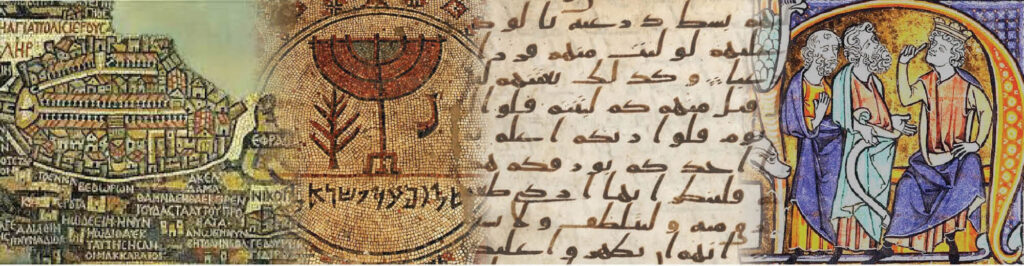
The Late Antique, Medieval, and Byzantine Workshop at Princeton University (LAMB) brings together graduate students from across departments and disciplines who study and research any region ca. 300-1500 CE, and offers an opportunity to present and discuss their research with others from within and outside their fields.
In addition to providing scholarly support, development, and camaraderie, LAMB prepares us to flourish after graduation. Pre-modernists are often tasked with teaching across geographies and time periods. Learning from each other through workshops provides an opportunity to put our research and our disciplines in conversation with one another. This is essential since medieval studies is unusually interdisciplinary by design, necessity, and institutional history.
The LAMB Organizing Committee for 2026-2027 is Nikita Bogachev (HIS), Izzy Friesen (CLA), Zihan Guo (EAS), Lizzy Hane (REL), Lisa Marzahn (A&A), and Gabriel Medina (ENG).
If you would like to be on our email list to hear about future events, please contact: anna.delia@princeton.edu.
The workshop is co-sponsored by the Program in Medieval Studies, the Center for Collaborative History, and the Departments of Art & Archaeology, Classics, East Asian Studies, English, and Religion.
Statement on Racism and Euro-Centrism
As the next generation of scholars of the medieval world, the board of LAMB stands unequivocally against the racism of the modern world and the weaponization of the medieval past by white supremacists. We commit to actively work against racism in our fields, which have long been guilty of (if not founded upon) Euro-centric, Orientalist, and other entrenched forms of thought.
We acknowledge our own complicity, that we ourselves have often inadvertently perpetuated these narratives and that our own institution’s history has been deeply intertwined with slavery and racism.
We also acknowledge our need to listen, reading voices of color and elevating historical narratives too long neglected by the academy. It is our responsibility to educate ourselves and to avoid placing an additional burden upon those communities experiencing racism and discrimination by asking them to correct our ignorance and distorted perspectives.